Hello! It's been a long while since the last update... November was a slow month, but December brings lots of exciting places / activities, beginning with last Sunday's Sungei Buloh Anniversary Walk! Jasela and Yuxian, who also came for the Kusu Island reef walk / picnic, joined me in yet another nature adventure :).
Huge props to everyone who turned up, since the walk started at 8am in the morning on a Sunday. Biggest. Challenge. EVER.
6th December 2012 marks the 19th anniversary of Sungei Buloh's official opening by then-PM Goh Chok Tong. Sungei Buloh was Singapore's first gazetted wetlands reserve, and also our first ASEAN Heritage Park, due to the many species of migratory birds which stop here every year. As far as I know, it's the most famous and accessible mangrove reserve in Singapore.
The Raffles Museum Toddycats conduct an anniversary guided walk around Sungei Buloh every year, and are a veritable fountain of knowledge about all things Nature in Singapore - keep a lookout for their programs for fun and educational activities!

"Buloh" = "bamboo", and in all my previous visits to Sungei Buloh during secondary school, I never actually noticed the bamboo plants (bamboo is a kind of grass, not a tree) around the park. This time we saw 3 kinds just in the vicinity of the visitors' centre and boardwalk alone, thanks to our eagle-eyed guide who put all us youngsters to shame.
Our tour started at the Visitors' Centre and only took us around the boardwalk area, as well as across the Sungei Buloh Besar river to the mud flats where the migratory birds are. This was the first time I'd been to Sungei Buloh during migration season, so seeing all the birds was beyond exciting!

The longest trail (the red trail) is a 7km round trip! If you walked to the end, you'd see prawn farms which have been around for decades and are still in use.

The section of Sungei Buloh which our tour covered.
Our friendly guide for the day was Kok Oi Yee, a true veteran in zoology and botany who's been in the field since 1960. She started out by introducing us to the famous mud lobster mound, a common feature around the whole park that can reach heights of almost 7ft!

Large model of a mud lobster mound at the visitors' centre.
We then started on the boardwalk and were quickly acquainted with the flora and fauna of Sungei Buloh, ranging from kampung plants to stingrays!


Oi Yee points out Torch Ginger, a kampung plant brought in by old settlers. The flower is starting to bloom now, but hasn't got the characteristic deep red colour yet.
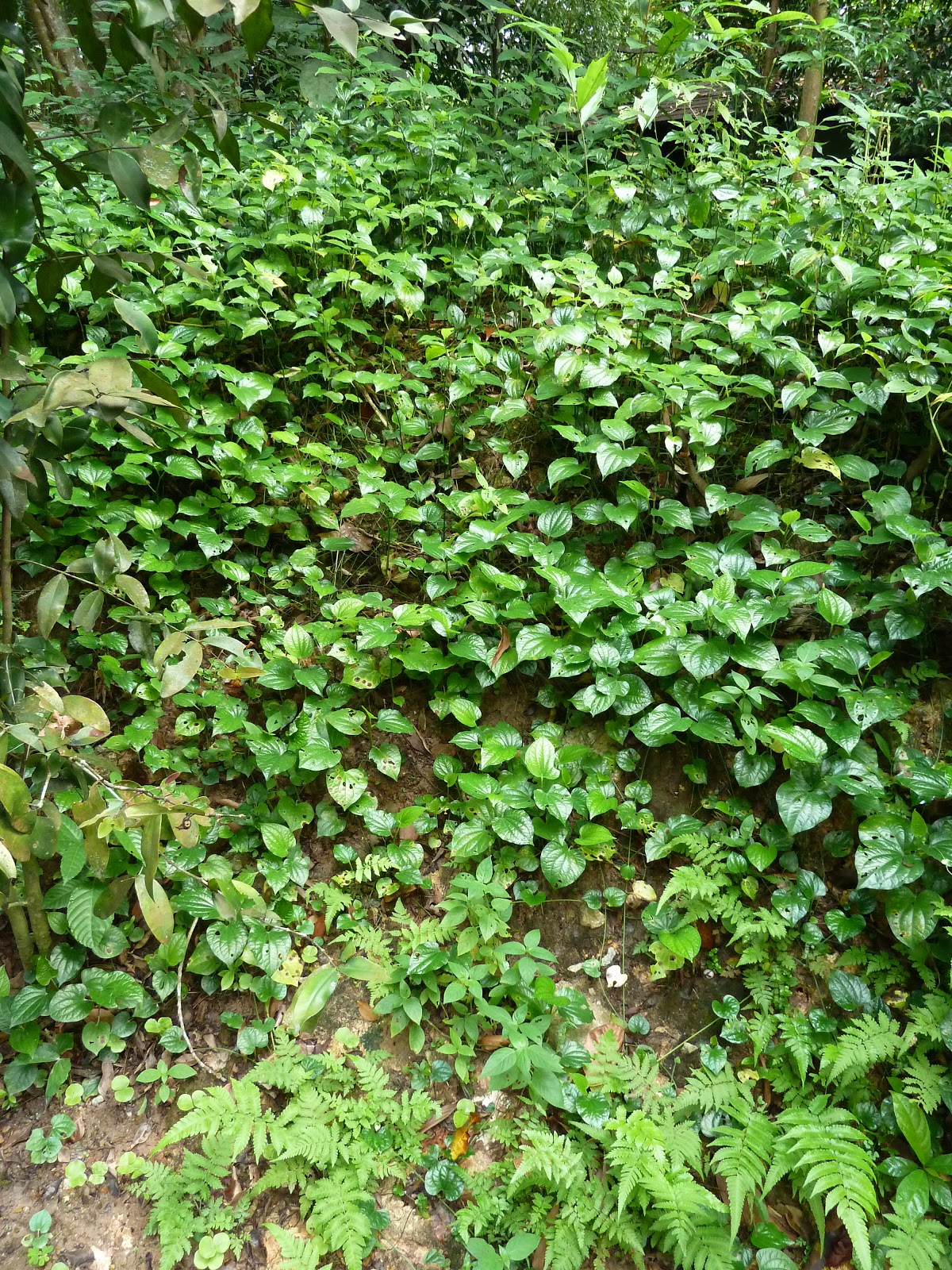

The Beetlenut Leaf covers the flanks of mounds, deliberately grown there to prevent soil erosion.
It's actually a kind of wild pepper, and edible!
It's actually a kind of wild pepper, and edible!

Holes in the leaves of the Sea Hibiscus, caused by the Stink Bug.
Don't let the bug near you or the smell will stay on your skin for 2 days...
Don't let the bug near you or the smell will stay on your skin for 2 days...


Tree-climbing crabs!
Fun fact: these are the crabs you're eating when you order "soft-shell crab" at a restaurant. Or sometimes you throw them in a bucket of vinegar and soy sauce for teo chew-style.
Fun fact: these are the crabs you're eating when you order "soft-shell crab" at a restaurant. Or sometimes you throw them in a bucket of vinegar and soy sauce for teo chew-style.

Another crab, but I have no idea what species.

Sea holly

As we approached the shore, we saw the changing types of roots of the mangrove trees. For those who've forgotten their secondary school ecology: inland there are the pencil roots of the Avicennia and knee roots of the Bruguiera. Further towards the waters there are the stilt roots of the Rhizophora.
The prop roots are important as fish nurseries, because large predators can't get in between the roots, giving the little fishies a safe place to grow =).


Left: pencil and knee roots
Right: relaxing in a hut next to all the Rhizophora
Right: relaxing in a hut next to all the Rhizophora

Flower of the Bruguiera

Chilling with Jasela.
While we were resting in the hut at the midway point of the boardwalk, Oi Yee recounted how the International Coastal Cleanup Singapore (ICCS) started (some of us might remember taking part in it during primary/secondary school). The ICC is an international effort where on the 3rd Saturday of each September, almost 100 countries worldwide send out contingents of volunteers to clean trash from their coastlines.
Prior to 1992, the effort in Singapore was not official, and was apparently spearheaded by foreign teachers at our international school! It was only afterwards that Singaporeans stepped up our own efforts and the Nature Society started running the cleanups every year. Sometimes "foreign talent" does make a big positive difference :).

A mysterious propped net with a sign that's too small to read.
Leaf-fall experiment perhaps?
Leaf-fall experiment perhaps?


Nerita (left) and Algae-eating (right) snails. All edible.
Next time you're lost in a mangrove, you know what you can eat ;-).
Next time you're lost in a mangrove, you know what you can eat ;-).

The Ellobium snail, also edible! Roughly the size of your palm.

The source of ATTAP CHEE. Om nom nom.

Looking like a giant palm tree stuck in the ground, these are the Nypah palms, locally known as Attap, our source of kampung roofs and attap chee.
Note that attap chee is actually a gooey tasteless mass that's only sweet because it's boiled in sugar.

Prop/Stilt roots of the Rhizophora.
Did you know the Rhizophora is locally known as "Bakau" (fire)? This is the origin of wood for charcoal that we use in BBQs!

'Aaahhhhhhh it's an adorable MUDSKIPPER!'


More pictures of cute squishy mudskippers.

White collared kingfisher
This is a picture I'm very proud of. Because the last time I came and saw a kingfisher, it was too far away for my camera to take. Now with my awesome 16x zoom camera, I could actually capture it! Another lady in the tour had a Canon camera with a 20x zoom... I shall keep this in mind for my next camera buy.

Mangrove anemone


Stingray! (Not sure what kind)
This is why everyone who comes here should have a guide. Without our guide, we'd just have seen really muddy water.

Squirrel!


Jasela poses with a UFO-looking clump of bamboo (left) and we spot more regular-looking bamboo off in the distance (right).
We had to make our way back to the visitors' centre to get to the mud flats where the migratory birds were, so on the way we passed a bunch of interesting local plants, particularly some which NS boys would be familiar with ;-).


Flower (left) and fruit (right) of the Dillenia plant, also lovingly known as the "CB leaf" =P.

That pink thing is actually a whole bunch of snail eggs!

This is the Singapore Rhododendron, which is neither a rhododendron, nor found only in Singapore.
The scientific name for the Singapore rhododendron is Melastoma. For mysterious reasons I have a recollection of my secondary school bio teacher calling it a "Pontianak flower" because of the spindly, claw-like anthers, but the internet doesn't agree with me...

That plants growing where the branches meet the trunk of the tree are in fact orchids! This one is called the Tiger Orchid, because the flowers are yellow with black stripes, but it wasn't flowering so we couldn't get a good look.

SNAKE!
Can you spot it? In the bright daylight it was really hard to see in the shade of the tree branches. I think Oi Yee said it was a python, but I was far too excited by the idea of snakes in the wild within reaching distance on our shores to really think about what it was called.

Herons resting on the branches of the mangrove trees.

The view towards JB from the bridge across Sungei Buloh Besar.

Mud flats where the migratory birds were.
We finally reached the mud flats with LOTS OF BIRDS! I have very sub-quality pictures of them birds because I use a point-and-shoot. We passed at least 10 avid birdwatchers sporting bazooka lenses that were so big the tripods were attached to the lenses rather than the camera. They were at least half a meter long. I thought these amazon reviews were a cosmic joke until I saw real people with real lenses trooping through the wetlands in some remote corner of Singapore. I have been schooled.

Greenshanks!
We could identify them due to a handy chart in the bird-watching hut. That and my 99x digital zoom and a conveniently-located ledge to prevent my hands from shaking.
We could identify them due to a handy chart in the bird-watching hut. That and my 99x digital zoom and a conveniently-located ledge to prevent my hands from shaking.

These mercifully closer-to-my-camera-so-they-aren't-blur birds are Whimbrels.

Just as we were leaving a big Purple Heron landed on the strip of land near the hut!!! It was most exciting since they don't show up too often.

Our troop with our lovely guide, Oi Yee. Thanks for a great tour!
Bird-watching more or less rounded up our tour of Sungei Buloh; we could have walked the extra ~3 km to the tower where one could get a bird's-eye view of the reserve, but we decided we were far too hungry, so went back to the cafe at the visitors' centre for brunch.
A very educational morning, and lots of fun to see nature still thriving in our city which is being rapidly converted to concrete. Even though this walk by the Toddycats only occurs once a year, the reserve conducts its own FREE guided tours every Saturday, 9.30am.
Catch the migration season before it's over!
Next up: Legoland Malaysia!
-----------------------------------------------------------------------------------------------------------------
Budget!
Entrance fee - $1/pax
Saturday tour - FREE
Pre-booked tours - $60/group of 15
For more information on guided tours: https://www.sbwr.org.sg/events/guidedtours/
Saturday tour - FREE
Pre-booked tours - $60/group of 15
For more information on guided tours: https://www.sbwr.org.sg/events/guidedtours/


